
Exercise Periodization
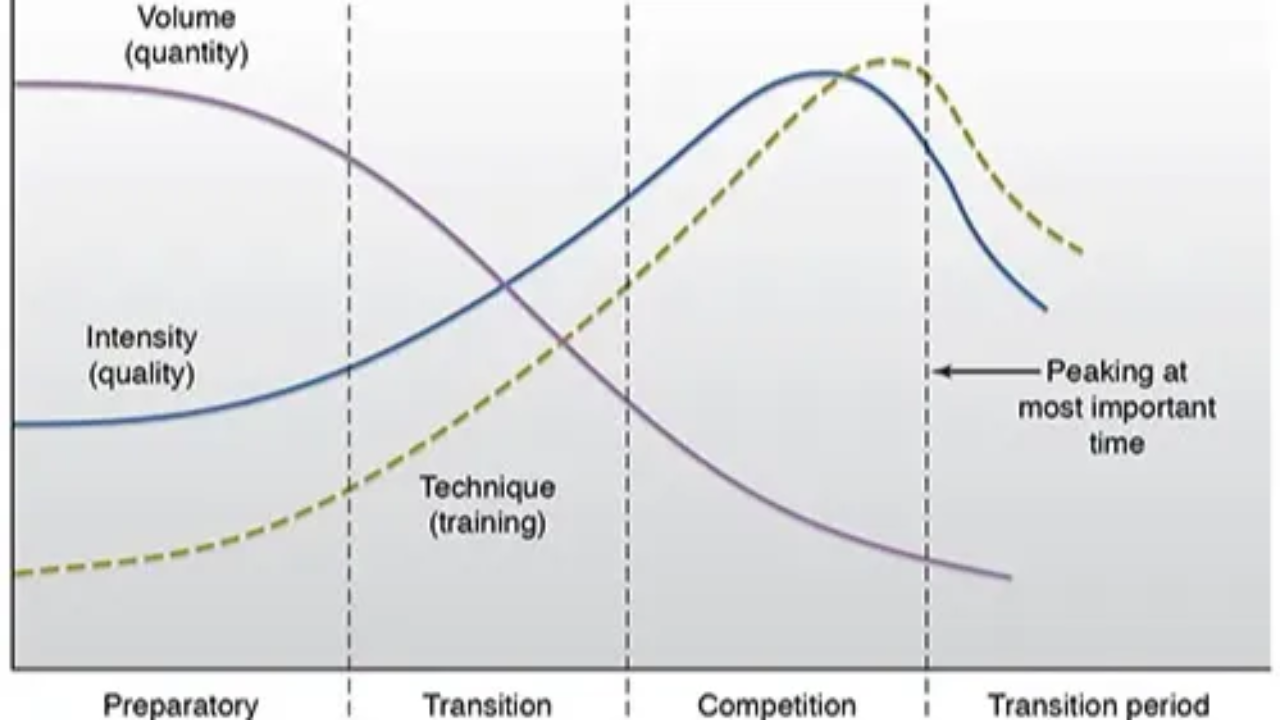
Jan 28, 2026Exercise periodization is the idea of structuring workouts around time frames usually based on goals or competitions for the year. These time frames are referred to as cycles. A macrocycle usually refers to a year, mesocycles to months, and microcycles to weeks. The type of periodization will vary depending on the amount of competitions/races during the year in an attempt to “peak” at the appropriate times. Simply put, exercise periodization is a way to structure training to maximize performance when it counts. There is little consensus in the research as to the most effective periodization strategy, much like there is some controversy about using specific rep ranges.
Let’s break down the three main styles of periodization: linear, non-linear, and block. Linear periodization is typically used with one main competition during the year starting with high volume, less specific training, and lower intensity and building over the course of the year to lower volume, higher specificity, and higher intensity. Immediately prior to the competition there is usually a short “rest” period in order to be both at peak performance and well rested going into a competition. Non-linear periodization uses more frequent changes in volume and intensity thought to help limit plateaus and may be useful for multi-event years. Block training, like the name implies, uses blocks of time to focus on specific adaptations and may be sport or season specific. Without strong support in the literature for one method of periodization over the other recommendations for choosing one style may not be the best question to ask, but one should ask rather, what are my goals, what will I adhere to best, what plan is most simple to follow, and what is my coach/therapist/trainer most versed in?
As I’m writing this, we are 4 weeks out from the 2026 CrossFit Open and programming has increased in specificity and intensity. With that there is usually an increase in soreness and injury. Here are some considerations leading up to the CrossFit Open. A lot of the programming I have seen is a hybrid non-linear or undulating style within training blocks. This allows for some specificity in training particular movements like the ring muscle-ups or front squat as an example, but while still varying reps and sets for any given workout. With large box gyms this programming can be very effective, but the programming has a hard time accounting for overall training volume. One gym member may go twice a week, another may go five times a week, and another may do CrossFit three times a week, run twice, and mountain bike on the weekends. This makes relying solely on the gyms programming impossible to use in isolation. The most simple bit of advice I could give would be to pay attention to your recovery following workouts. If you are maintaining normal levels of soreness the combination of volume and intensity may be the right fit for your routine. If the added intensity causes increased soreness, fatigue, if you’re getting sick, or performance inner optimize your recovery, or both. Recovery and volume are your two levers to pull as training intensity ramps up.
There is a growing body of research suggesting that sleep deprivation (seven or less hours of sleep) can almost double the risk of injury. Sleep may be the most important factor in improving performance and optimizing recovery. What is the quality of your sleep?
In summary, the important thing with long-term training strategy is to have a plan that is simple, that you will adhere to, and that will support your goals. As intensity increases nearing competition volume and recovery should be used to avoid injury and burnout. Exercise programming can be complex, but it doesn’t have to be. If you need help fill out the contact form on our website and mention exercise periodization and let us know what events you’re planning for and we’d be excited to support you.